Systematic exploration of a Retrieval-Augmented Generation pipeline with open-source tools. 10 notebooks benchmark each component (chunking, embeddings, retrieval, reranking, query translation, routing, advanced patterns, RAGAS evaluation), then a Chainlit application assembles the best choices into a local, streamed chat.
1. Pipeline Architecture
The project assembles a complete RAG pipeline that transforms a question into a sourced answer in four steps: split the documentation into chunks, vectorize them into a store, retrieve the most relevant ones for a query, then pass them to an LLM that generates its answer based solely on that context. Each step is isolated in a dedicated notebook, benchmarked with several alternatives, and evaluated on a standardized set of 25 questions with expert answers.
The corpus is the LangChain Python documentation (~1,463 pages fetched from GitHub). After cleaning (removing YAML frontmatter, MDX/JSX tags, base64 blobs, normalizing whitespace) and filtering out integration pages (90% of the corpus), ~130 core documents remain, forming ~1,500 chunks.
Everything runs locally with no API calls: Mistral 7B via Ollama for generation, mxbai-embed-large for embeddings, ChromaDB for vector storage, a cross-encoder for reranking. The entire pipeline is configurable through a single YAML file:
retrieval:
  strategy: hybrid
  dense:
    search_type: similarity
    k: 10
  sparse:
    k: 10
  hybrid:
    weights: [0.5, 0.5]
  final_k: 5

reranking:
  enabled: true
  model: cross-encoder/ms-marco-MiniLM-L-6-v2
  top_k: 5

query_translation:
  enabled: false

routing:
  enabled: false
Switching the retrieval strategy, enabling reranking, or swapping the embedding model requires no code changes.
2. Chunking and Embeddings
a) Chunking
Five splitting strategies were compared. The recursive splitter (which splits by \n\n, then \n, then . , then ) offers the best trade-off: fast (0.24s), good MRR (0.467), and homogeneous chunk sizes (~786 chars).
A grid search over size (500–2000) and overlap (0–400) confirms that 1000/200 is the optimal point. Beyond 200 overlap, gains are negligible.
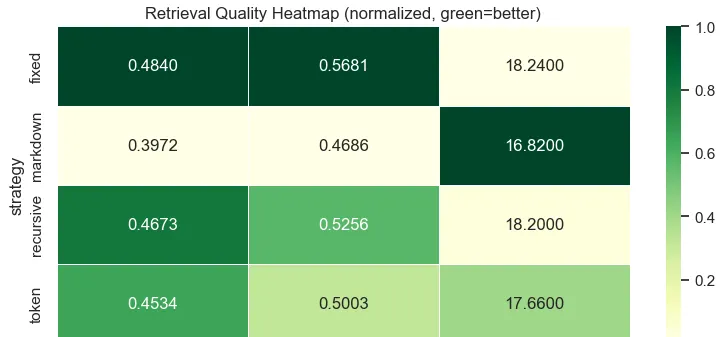
Figure 1 - Retrieval quality heatmap by chunking parameters
b) Embeddings
Four embedding models were evaluated. The decisive criterion is not raw MRR (not comparable across models) but semantic separation: the cosine similarity gap between relevant and non-relevant pairs.
| Model | Dims | Throughput (docs/s) | Semantic separation |
|---|---|---|---|
| all-MiniLM-L6-v2 | 384 | 102.3 | 0.131 |
| nomic-embed-text | 768 | 174.1 | 0.100 |
| BAAI/bge-small-en-v1.5 | 384 | 27.2 | 0.181 |
| mxbai-embed-large | 1024 | 72.8 | 0.207 |
mxbai-embed-large dominates with 0.207 vs 0.100 for nomic-embed-text, a +107% improvement in discriminating relevant documents. It is the model selected for the rest of the pipeline.
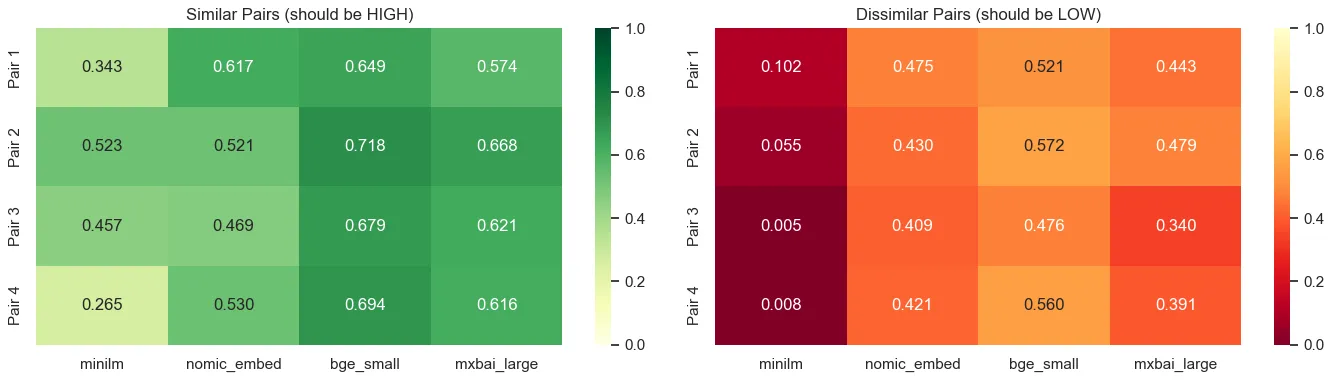
Figure 2 - Semantic separation by embedding model and by question
3. Retrieval Strategies
Five strategies were benchmarked. BM25 alone is insufficient for semantic queries (MRR 0.30 vs 0.60 for dense), but combined with dense via Reciprocal Rank Fusion, it captures both semantic matches and exact keyword matches. This is essential for technical queries containing class or function names.
MMR with lambda=0.9 is marginally better than pure similarity (MRR 0.605 vs 0.597), but forced diversity at lower lambda values degrades results. Multi-Query adds 100x latency (5s) with no improvement.
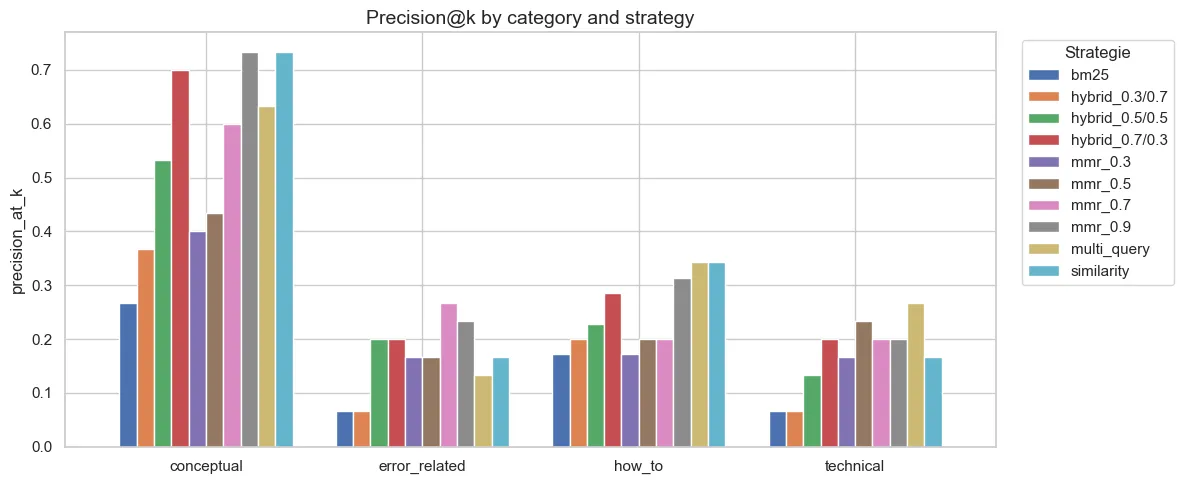
Figure 3 - Retrieval precision by question category and strategy
Conceptual questions are well handled by all strategies. Technical questions remain the most difficult across all configurations — a corpus limitation (few API reference pages survive the integration filtering).
4. Advanced Techniques: What Fails with a 7B Model
Several techniques designed for frontier models (GPT-4, Claude) were tested with Mistral 7B. The finding is clear: most of them fail or degrade results.
In query translation, five reformulation techniques were compared. HyDE (generate a hypothetical answer then encode it) is the only one that improves retrieval (+6.7% MRR), but at 141x the latency cost (2.7s vs 19ms). Multi-Query and Decomposition degrade results by -9% and -10% respectively because Mistral 7B generates imprecise or redundant variants.
In routing, directing queries to sub-indexes by category produces a 38% drop in MRR, even with 76% routing accuracy. The cause is a corpus imbalance: after filtering, tutorials contain 1,656 chunks versus only 1 chunk for the API reference.
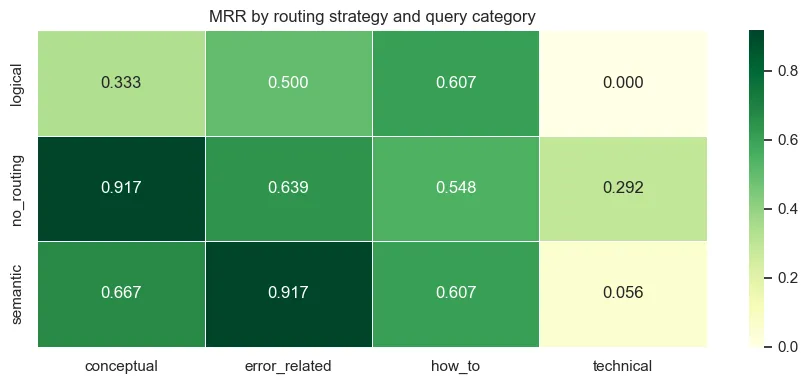
Figure 4 - MRR by routing strategy and query category
In advanced patterns (implemented with LangGraph), three architectures were tested. CRAG (Corrective RAG: score each document, rewrite the query if fewer than 50% are relevant) achieves a perfect MRR of 1.000, but at 450x the latency (8s vs 18ms). Self-RAG is broken: Mistral 7B systematically decides that retrieval is not necessary and hallucinates. Adaptive RAG is also broken: the complexity classifier labels all queries as “moderate”.
The pattern: CRAG works because its LLM task is simple (score yes/no). Self-RAG and Adaptive RAG require meta-reasoning beyond the reach of a 7B model. These techniques are disabled in the final pipeline.
5. Reranking
Reranking consists of retrieving 20 candidates then re-scoring them with a cross-encoder to keep only the top 5. Raw retrieval metrics show only a modest gain (Precision@5: 0.376 vs 0.352), but it is the RAGAS evaluation that reveals its true impact: +20% faithfulness and +19% relevancy. The cross-encoder does not necessarily change the document ranking, but it promotes those that enable the LLM to answer better.
LLM-as-Judge shows the theoretical ceiling (MRR 0.90) but costs 20 LLM calls per query (~8s), which is prohibitive.
6. RAGAS Evaluation
RAGAS evaluates four complementary metrics: faithfulness (does the answer follow the context?), relevancy (is the answer relevant?), context precision (are the retrieved documents relevant?) and context recall (was everything relevant retrieved?).
| Configuration | Faithfulness | Relevancy | Ctx Precision | Ctx Recall | Average |
|---|---|---|---|---|---|
| Naive (similarity only) | 0.747 | 0.603 | 0.996 | 0.782 | 0.782 |
| Hybrid + Reranked | 0.947 | 0.793 | 0.973 | 0.770 | 0.871 |
| HyDE | 0.869 | 0.666 | 0.990 | 0.673 | 0.799 |
The hybrid + reranked pipeline dominates with a 0.871 average, for only +35% latency over the naive approach. HyDE is the worst trade-off: 2.7x slower with the lowest recall. The +0.09 gap between naive and hybrid+reranked comes entirely from retrieval quality providing better context to the LLM.
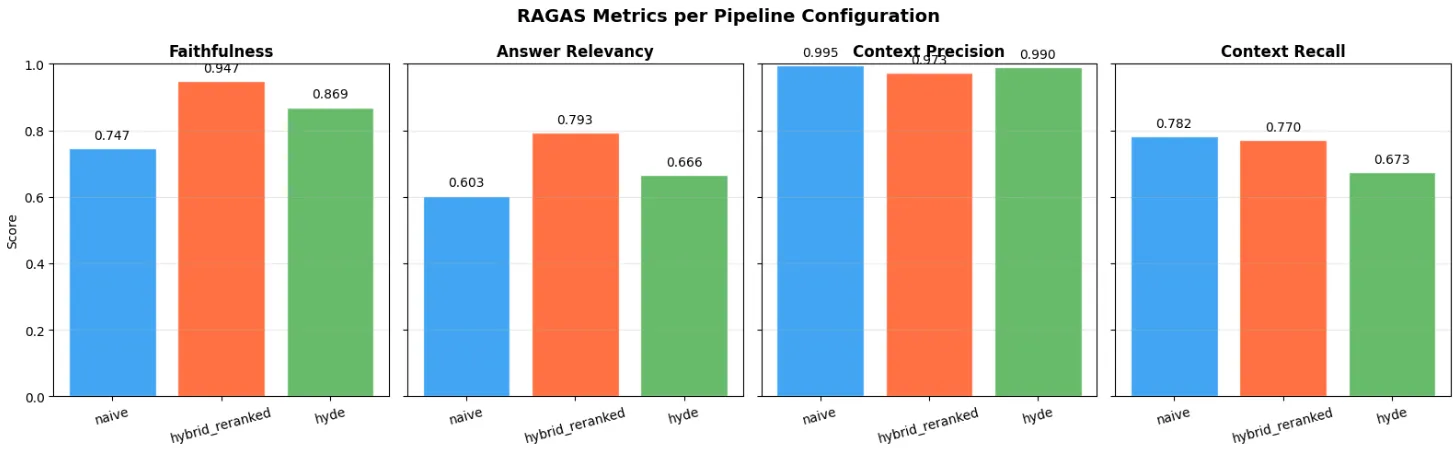
Figure 5 - RAGAS metrics by pipeline configuration
7. Final Pipeline and Chainlit Interface
The production pipeline assembles the best choices: recursive chunking (1000/200), mxbai-embed-large, hybrid retrieval BM25+Dense with RRF, cross-encoder reranking, and Mistral 7B for generation. Query translation, routing and advanced patterns are disabled as they provide no benefit or degrade results with a 7B model.
The Chainlit interface offers four modes (Simple, Hybrid, Hybrid+Rerank, Direct LLM), an interactive settings panel (number of results, source display, conversation memory), and token-by-token streaming. Each answer displays its sources in clickable panels that reveal the full retrieved chunk, along with timing metrics (retrieval, generation, total).
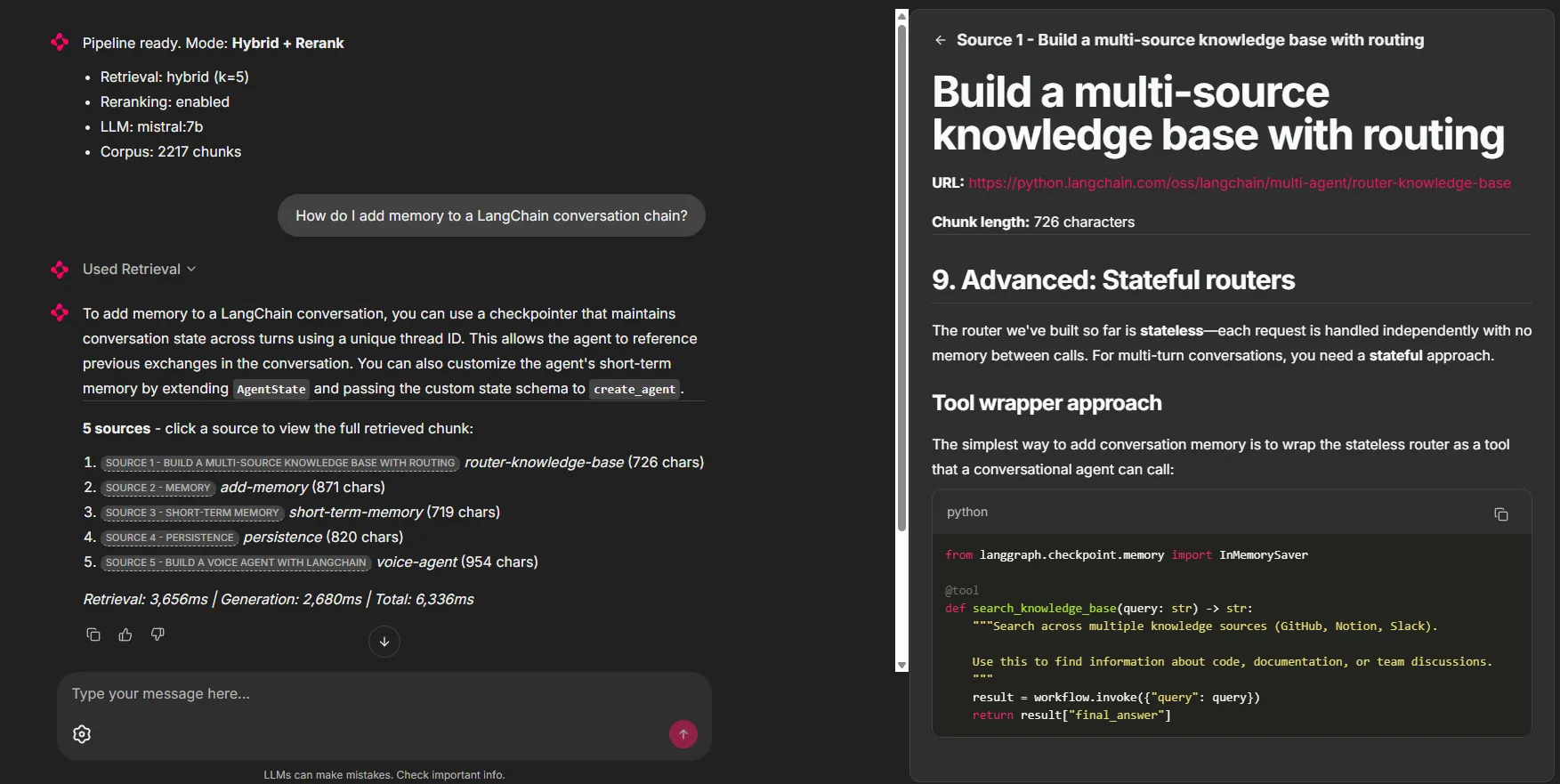
Figure 6 - Pipeline response to a question about conversational memory, with the 5 sources and retrieval/generation times
On the 25 questions of the final benchmark, the pipeline achieves an average RAGAS score of 0.874 (faithfulness 0.919, relevancy 0.846, context precision 0.954, context recall 0.777) with an average latency of 3.5s. Generation (Mistral 7B inference, ~3.2s) accounts for 91% of total latency. Retrieval including reranking weighs only ~300ms.
These projects might interest you
MCP Data Science
102 data science tools driven by natural language via Anthropic's MCP protocol.
OpenWhisper
Transcribe speech to text in real time, fully local, using faster-whisper and Tauri.